
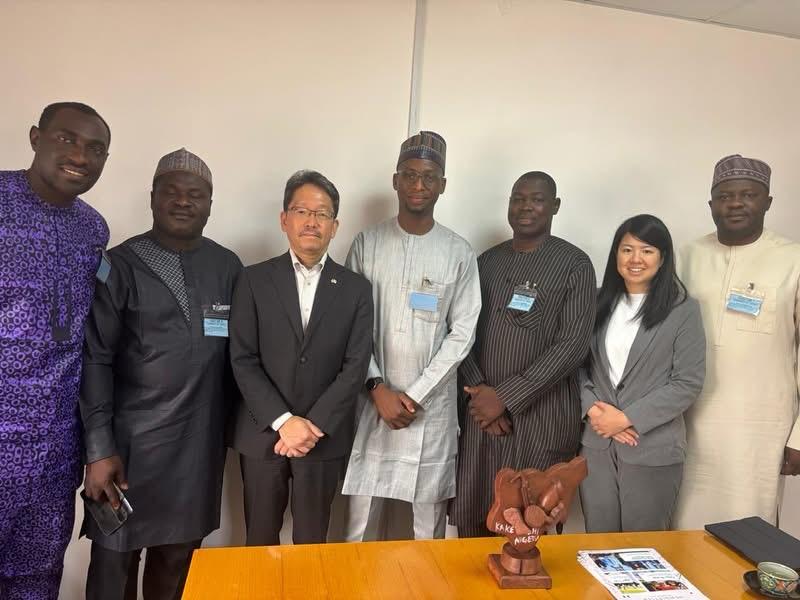
On 27 October 2026, I joined a delegation of the Kakehashi Africa Nigeria Initiative (KANI) on a courtesy visit to His Excellency Suzuki Hideo, Ambassador of Japan to Nigeria. For those of us who studied, lived and worked in Japan, sitting across the table from the Ambassador as partners in Nigeria’s development was a moment worth reflecting on.
The Delegation
The delegation was led by our President, Dr. Ibrahim Abubakar Masud. With him were Julius Agaka, Secretary-General; Lanre Ariyo, Treasurer; Akeem Adeyemi, Abuja Coordinator; and myself, as Chairman of the Board of Trustees.
The Ambassador received us alongside Ms. Asami Iba, Second Secretary for Economic Development Cooperation, and Mr. Sunday Ajibode Oluwatimileyin, Economic Development Cooperation Assistant. His Excellency reiterated the importance of Japan-Nigeria relations and encouraged continued engagement between the Embassy and KANI. We are grateful for the warm reception.
What We Discussed
The meeting covered cooperation between KANI and the Embassy, professional collaboration and knowledge exchange, connecting Japanese companies with Nigerian professionals and businesses, and opportunities for engagement with JICA, JETRO and other Japanese institutions.
Within that framework, the delegation shared its own thinking on where the relationship can grow.
1. Perception matters, and it is improving. The atmosphere between Japan and Nigeria feels better than before, helped by stronger public relations. But there is more to do. Accurate, up-to-date information on Nigeria’s economy and security is still needed. Many cities and business hubs are stable and open for business, and decision-makers deserve current facts, not outdated impressions.
2. Virtual and hybrid programs. We see value in joint programs, some virtual and some hybrid, that showcase opportunities in Nigeria and in Japan. Many Japanese and Nigerian organisations already work in Nigeria, and others do not yet. Both groups can be brought into the conversation.
3. Continuous capacity building. KANI already runs capacity-building activities, and we want to do more of them, across more areas.
4. More Japanese companies, starting from existing platforms. We discussed engaging more Japanese companies, including those already connected through JICA and others with a genuine interest in Nigeria.
5. Stronger public-private collaboration. The delegation stressed the need for more collaboration between the public and private sectors in Nigeria, and for practical programs and projects that Japanese and Nigerian companies can do together.
What KANI Brings to the Table
Our members are Nigerian alumni of Japanese universities. We came home with more than degrees, and three things stand out.
- Cultural translation. We understand how business and relationships work on both sides, and we can help break down cultural barriers before they become deal-breakers.
- Language and bureaucratic navigation. We can help bridge the language gap between Japanese and Nigerian systems and act as a window into the procedures that affect trade between the two countries.
- Public sector learning. Many of us have seen how Japanese prefectural, city and national offices operate. We see an opportunity to design training for federal, state and local government officials, drawing on what works in Japan, and where possible bringing practitioners to Nigeria to share it on the ground.
- Professional discipline. Punctuality and respect for time are central to Japanese business culture, and they matter just as much to Nigerian professionals who want to win Japanese partners. Time discipline is a skill that can be taught, modelled and measured, and it is a simple way to build trust from the first meeting.
Why This Matters for Business
I work in digital marketing transformation and market access, helping organisations enter new markets and build the digital presence and partnerships that make market entry succeed. That work has shown me one thing repeatedly: cross-border opportunities rarely fail for lack of interest. They fail because of information gaps, cultural misreadings and missing introductions.
That is why the bridge role matters. A Japanese company evaluating Nigeria needs credible local insight, the right contacts and a clear picture of the market. A Nigerian business seeking Japanese partners needs to be understood, found and trusted. Well-built digital channels, virtual showcases and hybrid events can do much of this work at scale, and a network of people who know both sides can make the introductions that count.
We thank His Excellency and the Embassy of Japan for their time and openness. We leave encouraged, and ready to turn conversation into collaboration.
Abdulazeez Idiaro is the Chairman of the Board of Trustees of the Kakehashi Africa Nigeria Initiative (KANI), and works in digital marketing transformation and market access and ICT.
Related posts:
 [Towards TICAD9] Supporting the further advancement of African students: We held an exchange meeting with ABE Initiative trainees
 Transforming Education through Innovation and Technology: Takeaways from Maiden IUJ Africa Day Symposium 2024
 [One of the superb participants] Digital Transformation and Glocal Approaches for Quality Education: Targeting to innovatively bridge the gap for all Africans
 Nigeria-Japan Business Partnerships: From Goodwill to Results Copy SEO title
 An Extract From “My Life” Originally Written By Late Alhaji Yusuf Idiaro
 Inside Subaru Automobile Manufacturing Marvel: A Deep Dive into behind the Scenes